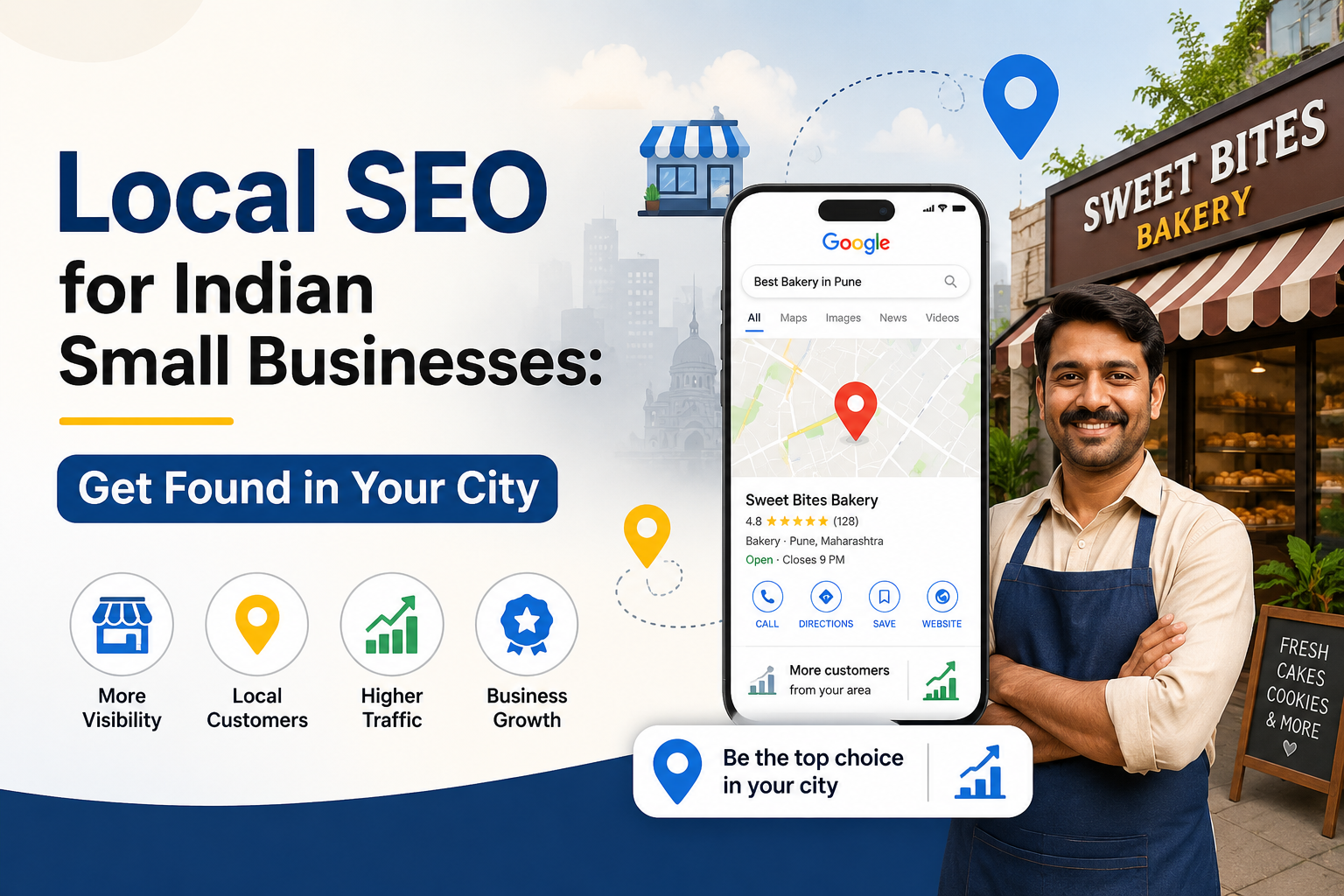
Why Local SEO Is the Highest-ROI Channel for Indian Small Businesses
When someone in Pune searches ‘plumber near me’ or in Surat searches ‘best CA firm Surat’, Google shows them LOCAL results — the Maps 3-pack and local organic listings. These results sit ABOVE most organic search results and often ABOVE paid ads.
Local SEO is the marketing channel with the highest purchase intent traffic available. Searchers are not browsing — they are actively looking to buy. For Indian small businesses, appearing in local search results is the single most cost-effective customer acquisition strategy in 2026.
The 6 Pillars of Local SEO for Indian Businesses
Pillar 1: Google Business Profile — Your Most Important Local SEO Asset
Your Google Business Profile (GBP) is what appears in Google Maps, the local 3-pack, and the Knowledge Panel on the right side of search results. A fully optimised GBP is the foundation of all local SEO.
Complete GBP Optimisation Checklist
| GBP Element | Optimisation Requirement | Impact |
| Business Name | Exact legal name — no keyword stuffing | 🔴 Critical |
| Primary Category | Most specific category available | 🔴 Critical |
| Address | Exact, matching your website and other listings | 🔴 Critical |
| Phone Number | Local number preferred over 1800 toll-free | 🔴 Critical |
| Business Hours | Accurate including public holidays | 🟠 High |
| Website URL | Direct to your website (not social media) | 🟠 High |
| Description | 750 characters, natural keyword use, compelling | 🟠 High |
| Photos | Minimum 10: exterior, interior, team, products | 🟠 High |
| GBP Posts | Weekly updates — offers, news, events | 🟡 Medium |
| Q&A Section | Add your own FAQs proactively | 🟡 Medium |
| Services List | Complete all services with descriptions | 🟠 High |
Pillar 2: NAP Consistency — Name, Address, Phone
Google verifies business legitimacy by cross-checking your NAP (Name, Address, Phone) across the web. Inconsistencies — different spellings, old addresses, multiple phone numbers — confuse Google’s local algorithm and hurt your rankings.
Every instance of your business information online must be identical to your GBP:
- Justdial, IndiaMart, Sulekha, TradeIndia — the most important Indian directories
- Facebook Business Page and LinkedIn Company Page
- Your website — header, footer, contact page, and schema markup
- Any industry-specific directories (legal, medical, real estate, etc.)
- Yellow Pages, Bing Places, Apple Maps
Pillar 3: Google Reviews — Ratings That Drive Both Rankings and Revenue
Google’s local algorithm uses review count, rating score, and recency as ranking signals. A business with 80 recent, genuine 4.5+ star reviews will outrank a business with 10 old reviews almost every time — regardless of website quality.
How to Get More Google Reviews for Your Indian Business
- Create a short review link: business.google.com → Get more reviews → Copy link
- Send the link via WhatsApp immediately after a successful service
- Add the review link to your email signature and printed receipts
- Ask verbally at the peak of customer satisfaction: ‘Would you mind sharing your experience on Google?’
- Respond to ALL reviews — both positive and negative — within 48 hours
- Train your customer-facing team to ask for reviews as a standard process
⚠️ NEVER buy fake reviews. Google’s spam detection systems are sophisticated and improving constantly. Fake reviews result in GBP suspension — which means complete disappearance from local search. This can take months to reverse. Always earn reviews authentically.
Pillar 4: Local Citations and Directory Listings
| Directory | Type | Priority | Cost |
| Google Business Profile | Universal | 🔴 Essential | Free |
| Justdial | Indian local | 🔴 Essential | Free (basic) |
| IndiaMart | Indian B2B | 🟠 High | Free (basic) |
| Sulekha | Indian local services | 🟠 High | Free |
| TradeIndia | Indian B2B | 🟠 High | Free (basic) |
| Bing Places | Universal | 🟠 High | Free |
| Facebook Business | Social | 🟠 High | Free |
| LinkedIn Company | B2B | 🟡 Medium | Free |
| Apple Maps Connect | Universal | 🟡 Medium | Free |
| Industry directories | Niche-specific | 🟡 Medium | Varies |
Pillar 5: Local On-Page SEO — Telling Google Which City You Serve
Your website must clearly signal to Google exactly which city, district, or area you serve. This is done through on-page content optimisation:
Local Keyword Formula
[Service] + [City / Area / Neighbourhood]
Examples: ‘best CA firm Ahmedabad’, ‘web design company Vastrapur Ahmedabad’, ‘interior designer Indiranagar Bengaluru’, ‘dentist in Bandra Mumbai’
On-Page Local SEO Checklist
- Include city name in your homepage title tag and H1 heading
- Create dedicated landing pages for each city or area you serve
- Add LocalBusiness schema markup with exact NAP data to homepage
- Embed a Google Maps iframe on your contact page
- Write content that references local landmarks, events, and customer names (with permission)
- Include your city in image alt text where relevant
Pillar 6: Local Content Strategy — Content That Ranks in Your City
Creating content specifically about your local area and market helps Google understand your geographic relevance:
- Blog about local business news, events, and industry developments in your city
- Create ‘Best of [City]’ guides related to your industry
- Write case studies featuring local client names and locations
- Cover local regulations or policies relevant to your service area
- Partner with other local businesses for joint content and cross-linking
Local SEO Timeline: What to Expect
| Timeframe | Expected Results | Priority Actions |
| Week 1–2 | GBP verified and fully optimised | Complete all GBP fields, add minimum 10 photos |
| Month 1 | First review responses and new reviews | Launch WhatsApp review request campaign |
| Month 2–3 | Appearing in local 3-pack for some long-tail terms | Build directory citations, add local schema |
| Month 3–6 | Top 5 local rankings for medium-competition terms | Regular content, ongoing review collection |
| Month 6–12 | Dominating local results for your primary category | Advanced content strategy, competitor gap analysis |
Want to Get Found by Local Customers?
Local SEO is one of the highest-ROI moves a small business can make. Explore our local SEO and digital marketing services, or get a free consultation with the Vansys Technologies team.
Related reading: How to Rank #1 on Google India in 2026 · 10 Free SEO Tools for Indian Businesses